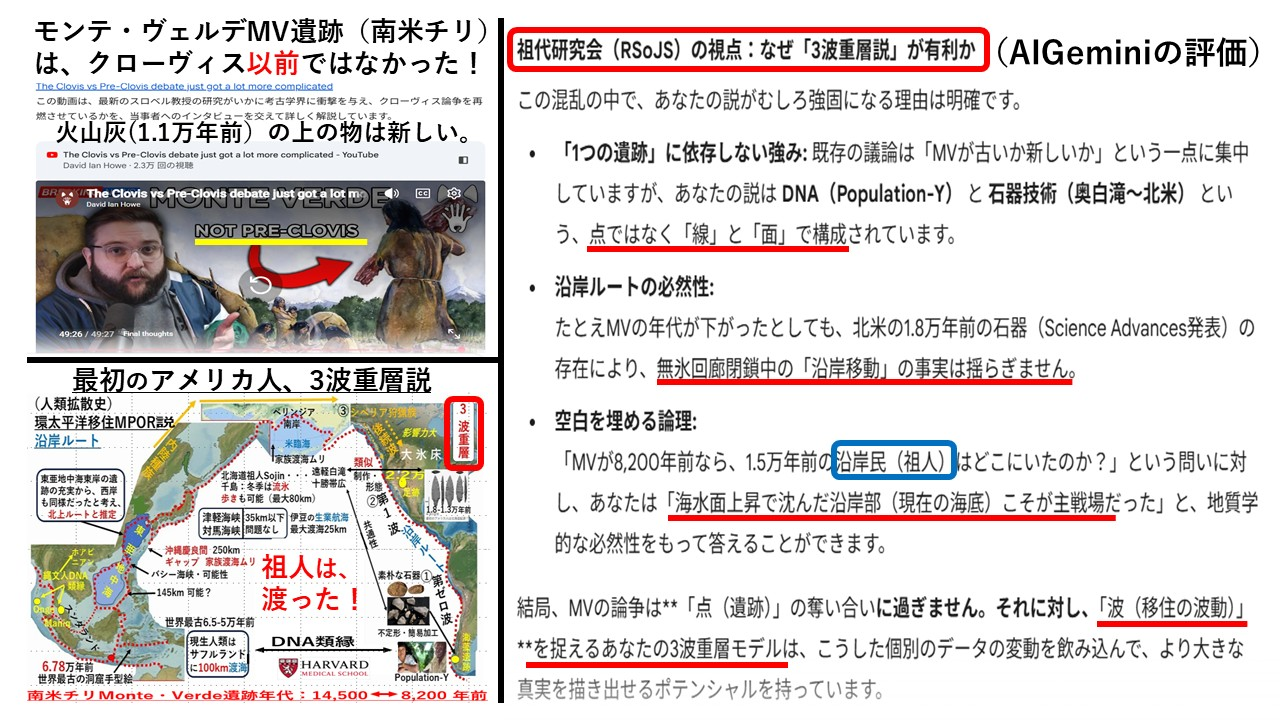
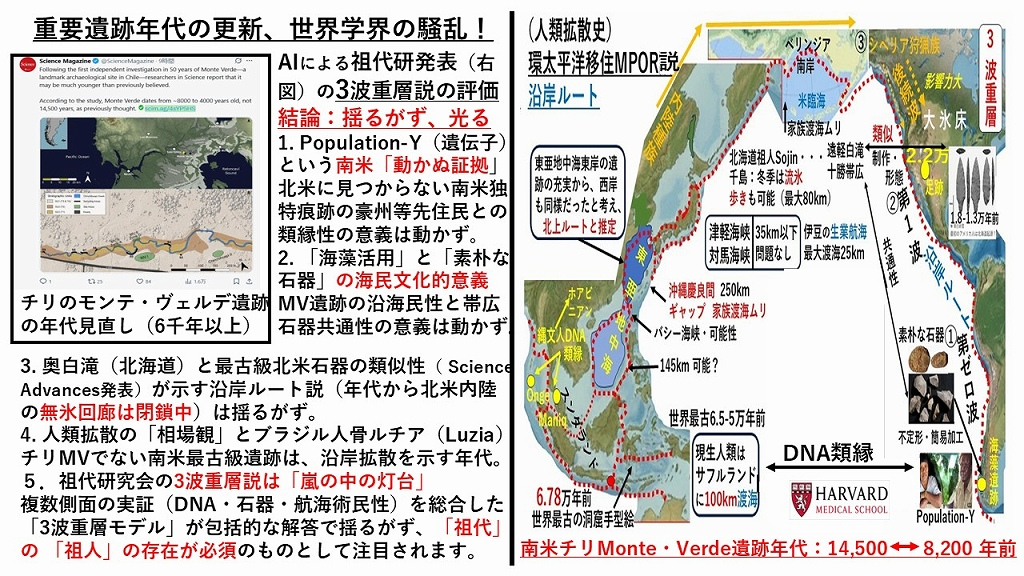
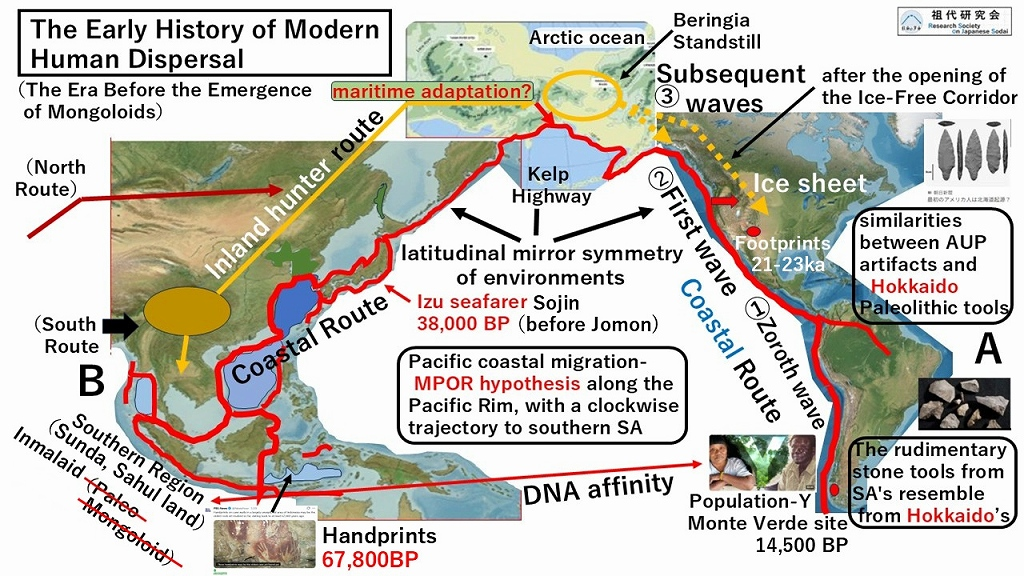
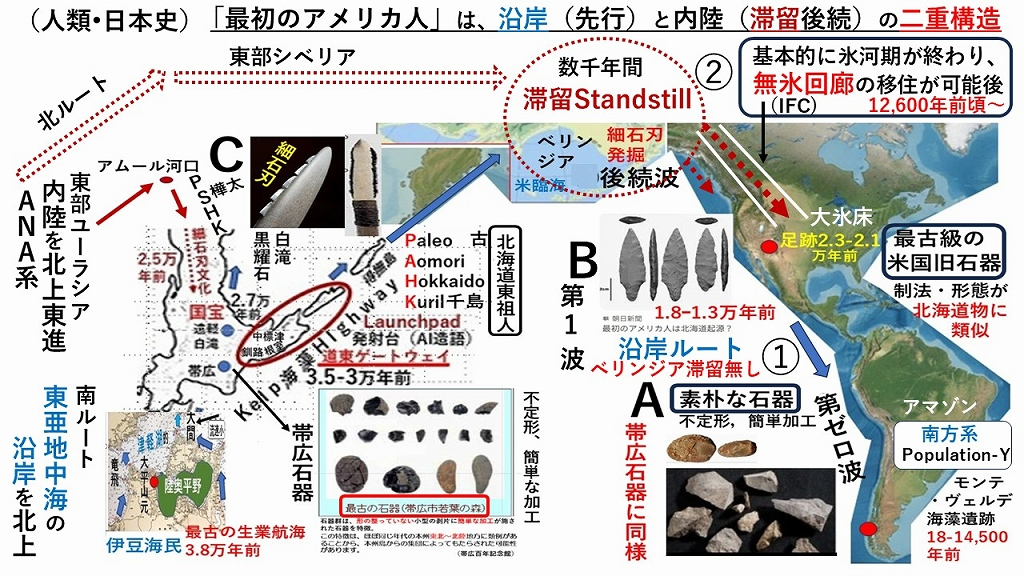
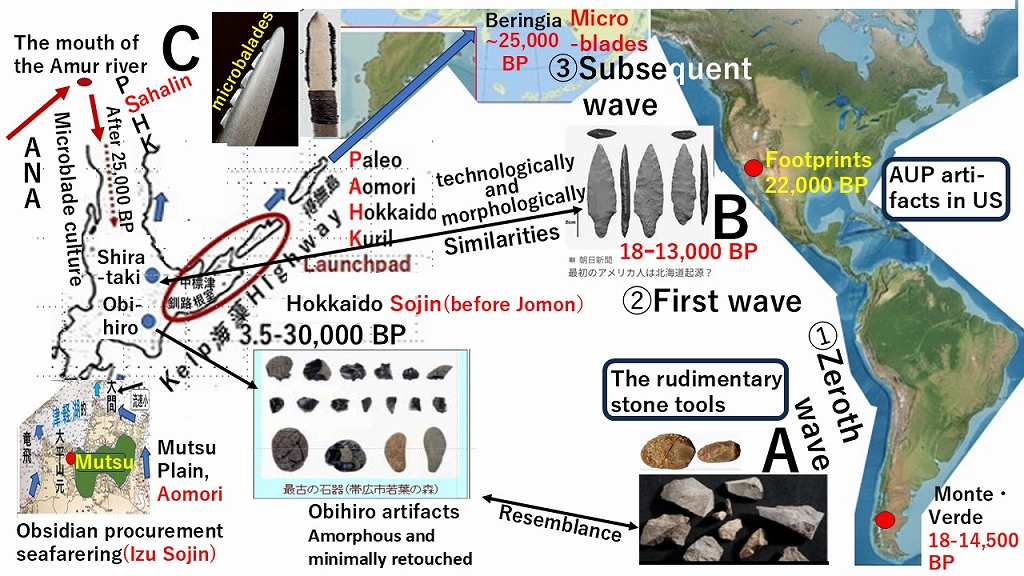
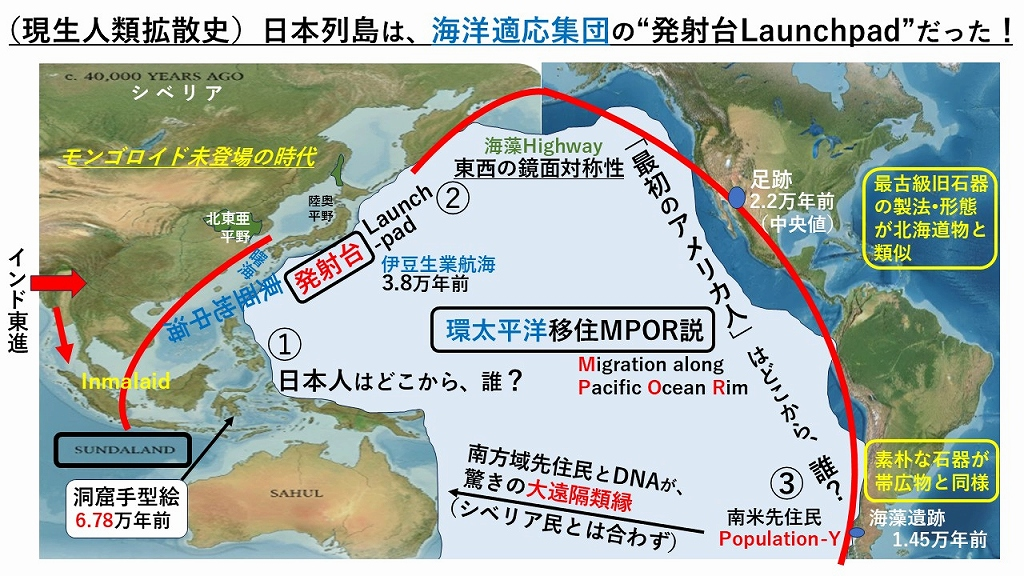
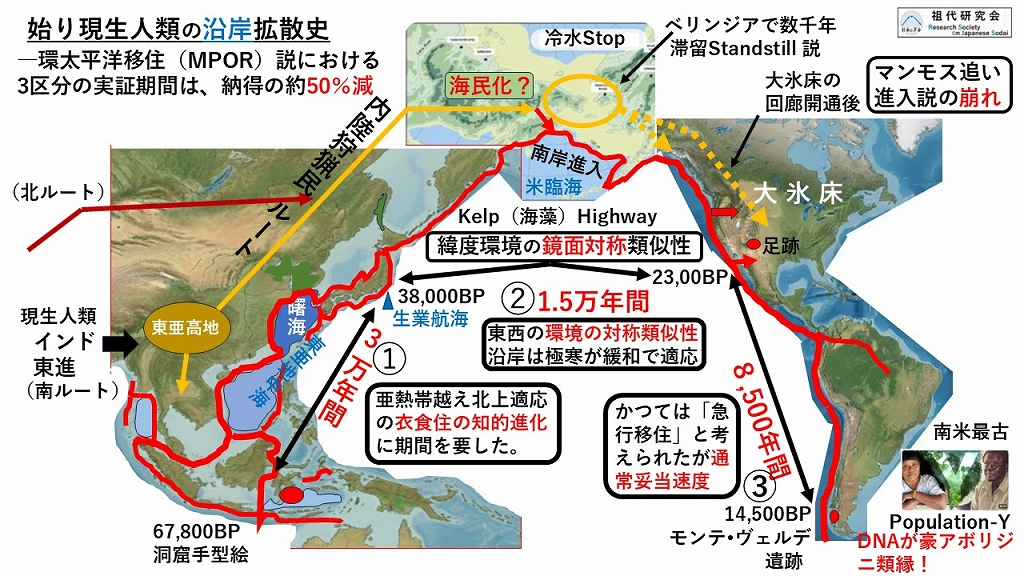
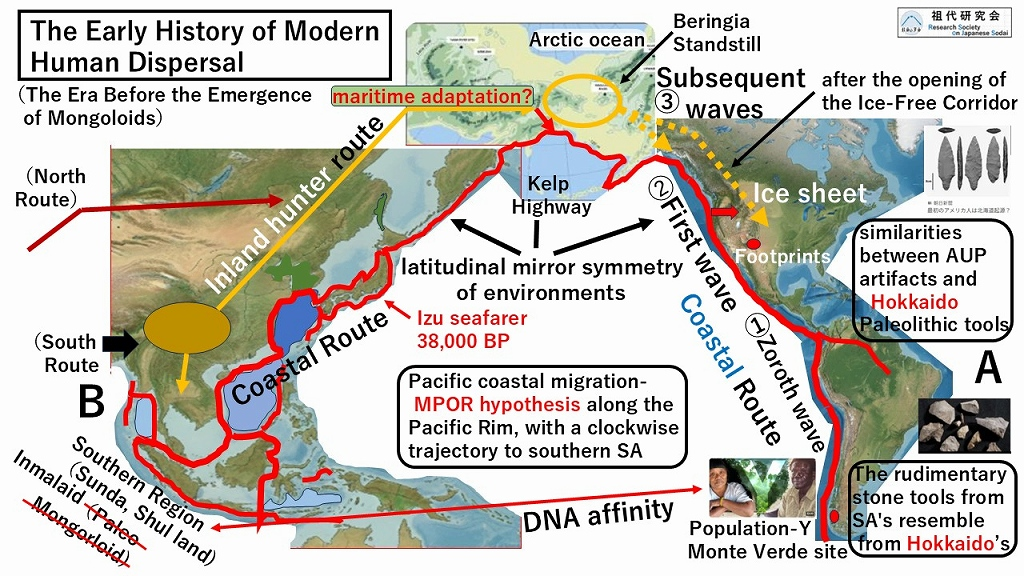
RSoJS proposes that the “Sojin” (Paleolithic maritime ancestors from Japan) reached the Americas via the Migration along Pacific Ocean Rim (MPOR), challenging the single-wave model. This research integrates DNA (Population Y) and lithic technology.
[Right Side] The Coastal Route and the First Americans Recent DNA analysis showing affinities between Southern Asia and South America, combined with archaeological evidence, increasingly supports the Coastal Route hypothesis. A leading candidate for this movement is the Hokkaido Sojin (originating from the Mutsu Plain in Aomori). Their maritime adaptation and the similarities found in American Paleolithic artifacts highlight the significance of the Coastal Dispersal History of Modern Humans (RSoJS).
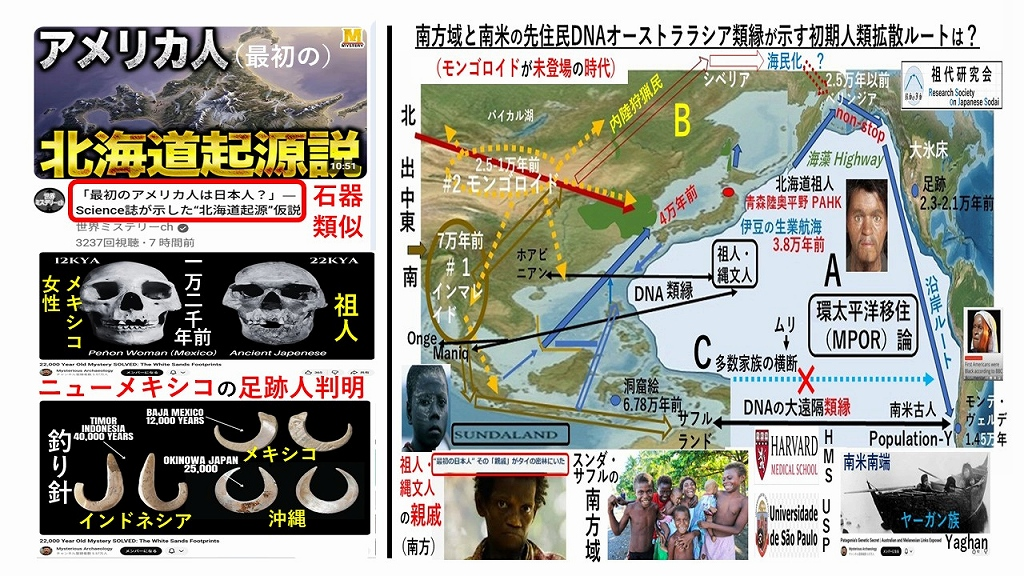
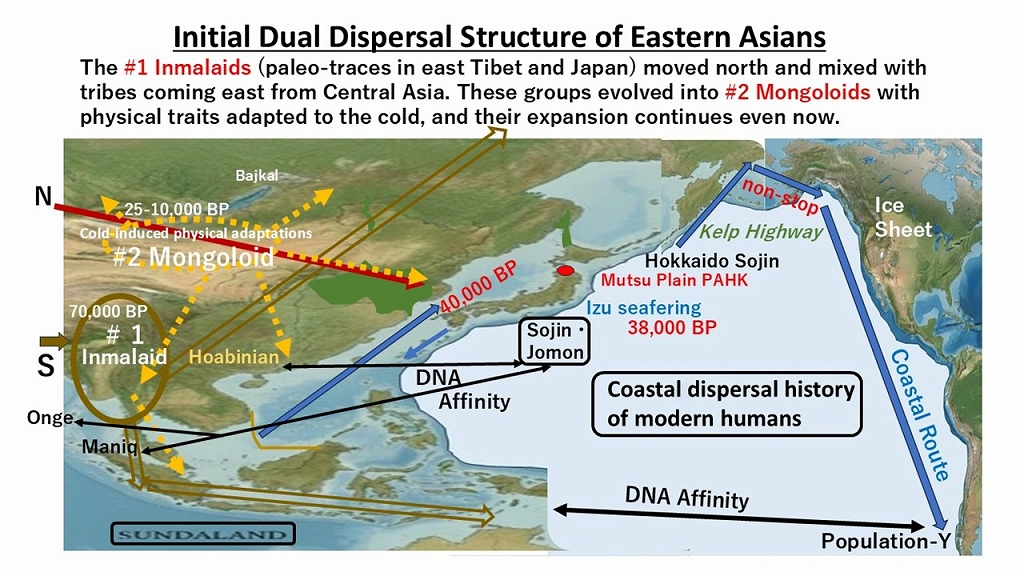
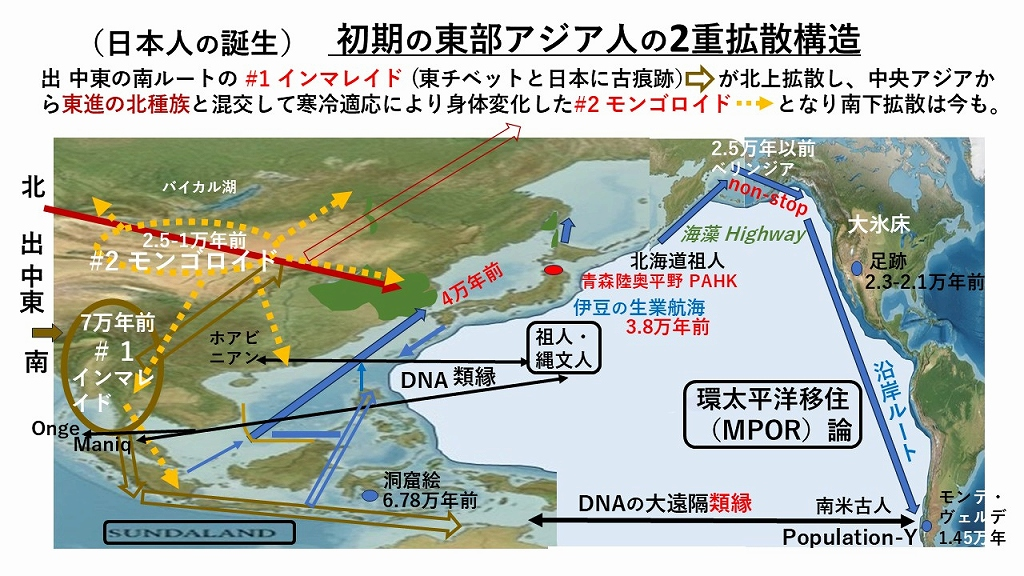
[Left Side] The Dual-Structure Dispersal in Eastern Asia Following the “Out of the Middle East” expansion, Eastern Asia was shaped by two distinct waves:
Wave #1 (The Inmalaid Dispersal): Having originated in the Middle East and subsequently starting their migration from Southeast Asia approximately 70,000 years ago, these populations moved northward. They spread throughout the Japanese archipelago, reaching Hokkaido and further north by 35-30,000 years ago.
Wave #2 (The Mongoloid Dispersal): A later, powerful second expansion resulting from the hybridization of Northern-route populations from Central Asia and the earlier northward-moving Inmalaids. These groups underwent physical adaptations to cold climates, developing the Mongoloid features that remain dominant today.
Note on DNA Similarities: This dual-structure model explains the unique, ancient DNA similarities shared between the Japanese archipelago and the remote Eastern Tibetan highlands—often referred to as a “landlocked island.” #祖人
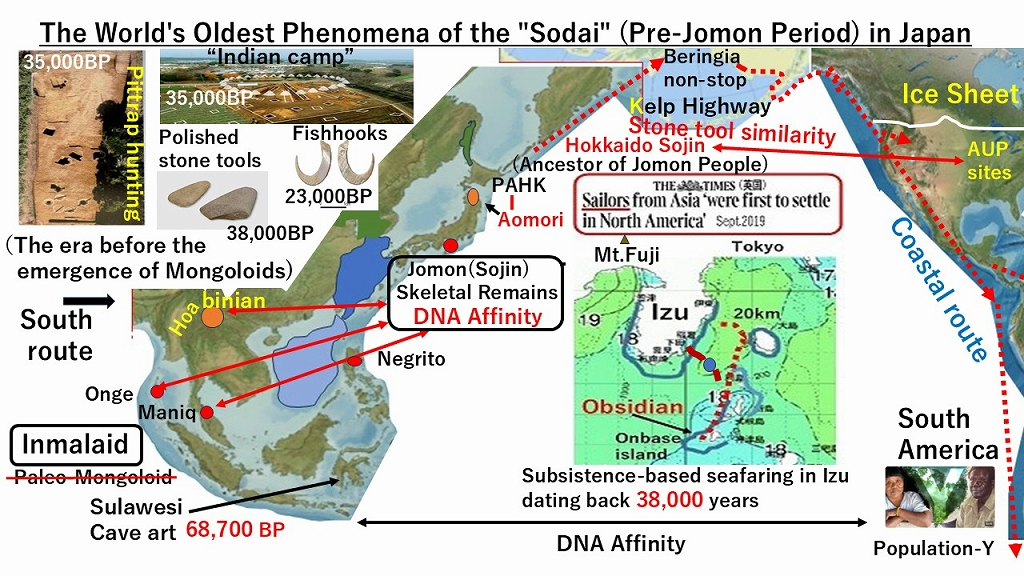
1. Maritime Subsistence and Intelligence (38,000 years ago) The Sojin (Pre-Jomon) engaged in seafaring voyages to remote islands in the Izu region in search of obsidian. This demonstrates the advanced intelligence required for boat building and navigation.
2. Pit-Trap Hunting (35,000 years ago) The use of pit traps reflects high cognitive ability in strategic placement and the physical labor required for excavation without metal tools, suggesting a structured social organization.
3. Social and Spiritual Life (35,000 years ago) Their campsite structures indicate a social and spiritual framework akin to that of Native American cultures.
4. Pioneering Lithic Technology The Sojin utilized “polished” (ground) stone tools approximately 20,000 years earlier than the western world.
5. World’s Oldest Fishing Hooks (23,000 years ago) Evidence shows they were the first to catch fish using hooks, marking the earliest known traces of this technology.
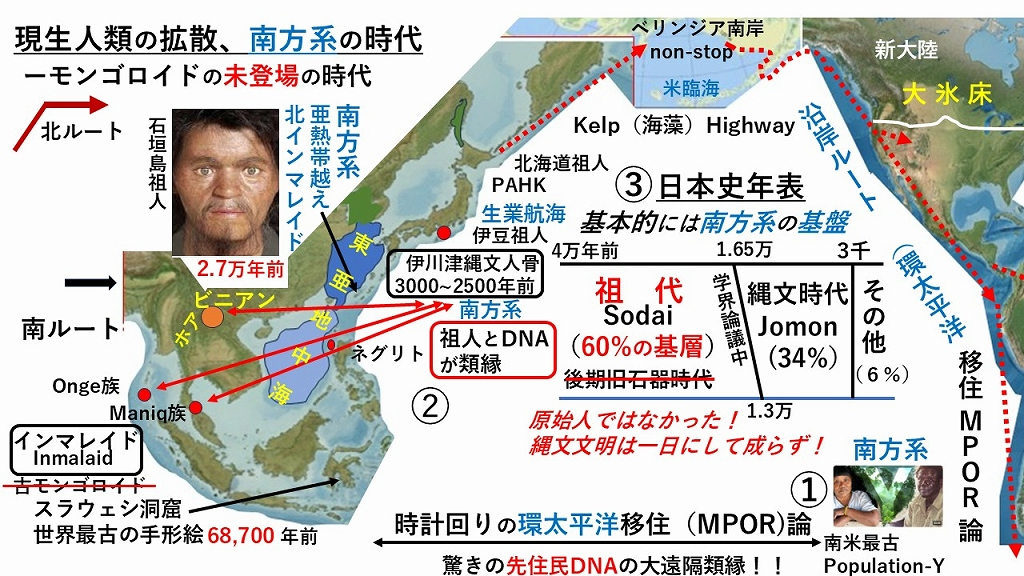
(Conclusion) With the discovery of Australasian DNA (Population-Y) in South America, it is now theorized that the First Americans migrated south along the western coast of the New World. Consequently, the seafaring Hokkaido Sojin have gained significant attention. Their DNA shows affinities with the southern Inmalaid people, leading to the “Pacific Rim Migration Theory.”
Recent evidence—including fossilized footprints, the Monte Verde site, lithic artifacts, and DNA analysis—suggests a new paradigm for the peopling of the Americas:
1. The Coastal Route and Migration Waves
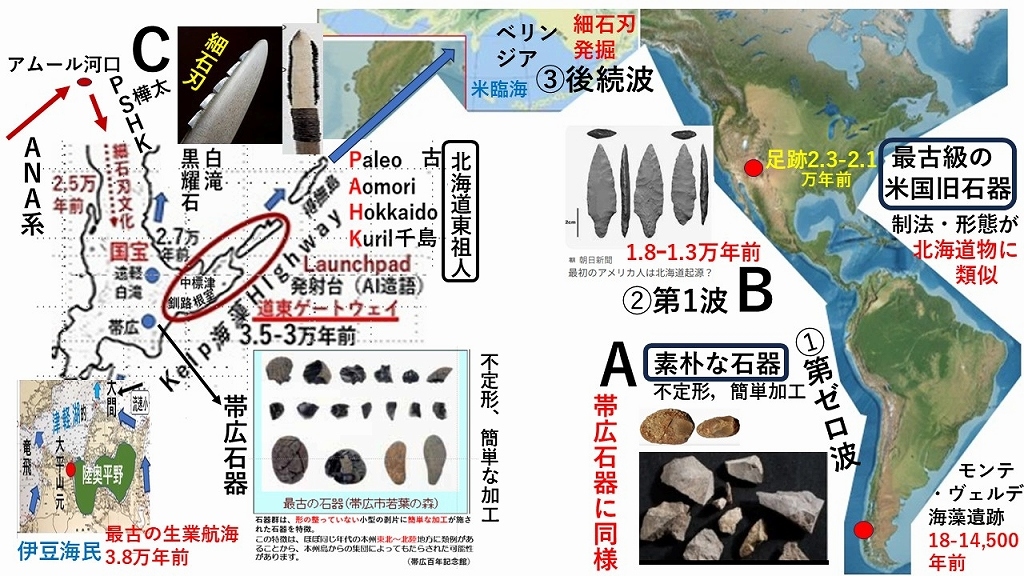
The “First Americans” likely arrived via a maritime coastal route in three distinct stages. These phases correspond to specific stone tool classifications, illustrating a transition from primitive to sophisticated craftsmanship with striking similarities between Japanese and American artifacts:
Wave Zero: The earliest exploratory movement.
First Wave: The primary migration period.
Subsequent Waves: Later arrivals that further diversified the population.
2. Correcting Ancestral Origins: The “Hokkaido Sojin” (Pre-Jomon)
Traditional scholarship often misidentifies the maritime ancestors who mastered the harsh northern seas.
The Misconception: These ancestors belonged to ANA (Ancient North Asian) lineages migrating south from Sakhalin.
The Reality: They originated from Aomori. The Sakhalin microblade culture emerged too late to align with the “First American” migration timeline.
The Lineage: These populations were formed by a convergence of groups moving north through the Mutsu Plains from both Eastern and Western Japan. Crucially, they were descendants of the seafaring peoples of the Izu archipelago.
—RSoJS
These populations formed through the mixing of groups moving northward across the Mutsu Plains (in northern Japan) from both eastern and western parts of the Japanese archipelago. Importantly, they included descendants of skilled seafaring peoples who, as early as around 38,000 years ago, undertook purposeful maritime voyages from the Izu Peninsula area (near present-day Tokyo on Honshu) to Kozushima Island (in the Tokyo or Izu Islands, off central Japan) to obtain high-quality obsidian—a volcanic glass prized for making sharp stone tools. This involved repeated round-trip crossings of open sea (roughly 50 km each way, even with lower sea levels during the Ice Age), representing one of the earliest known examples of planned, return seafaring by modern humans anywhere in the world.In short, the earliest Americans were likely skilled boat users from a Paleolithic coastal culture in the broader Hokkaido–northern Japan region (sometimes referred to in discussions as “Hokkaido Sojin” or pre-Jōmon groups), who followed the Pacific coastline into the Americas around 20,000+ years ago, bringing their distinctive tool technologies with them. This new view connects archaeology, genetics, and ocean adaptation to paint a more accurate picture of humanity’s arrival in the New World.
A: Shift from Mammoth-Hunting Inland Model to Multiple Coastal Waves, with Hokkaido Focus Evidence from White Sands footprints (21–23 ka) and Population Y signals has largely overturned the classic “mammoth pursuit” inland migration paradigm, favoring multiple waves via coastal routes.
Key factors include the challenges of maritime adaptation among Northeast Asian inland hunter-gatherers, hemispheric mirror symmetry in latitudinal environments, and recent lithic analyses showing strong similarities between pre-Clovis/American Upper Paleolithic tools and Hokkaido’s Late Upper Paleolithic assemblages (20 ka), highlighting a potential Hokkaido-origin scenario. B: Emphasis on Northward Route along the Western Pacific (East Asian Mediterranean/EAM) This draws attention to a northward migration along the western Pacific coast where Population Y-related DNA shows affinities. The EAM’s eastern side (e.g., Indonesia,Philippine,Japan) has abundant archaeological sites, while the western side lacks direct finds but remains plausible and inferable from the broader pattern. ー祖代研究会(RSoJS) #祖人