
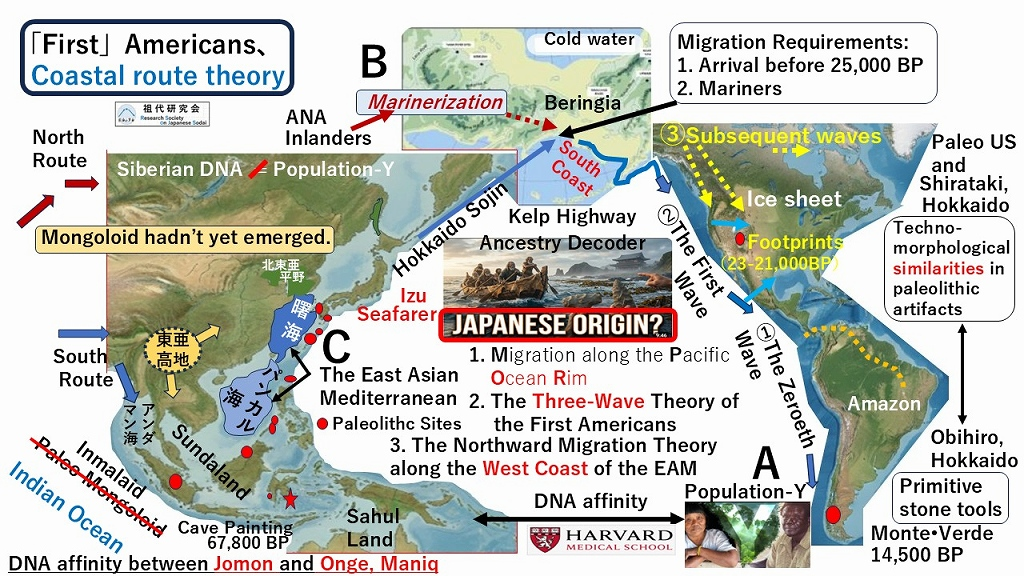
A: Shift in the Migration Paradigm
The traditional theory of mammoth hunters entering America via an inland route has collapsed. New evidence, such as the surprising discovery of Australian-related DNA in South America, crude stone tools and seaweed remains at ancient Chilean sites before Clovis, and the dating of footprints in North America, has shifted the consensus toward the Coastal Migration Route. Furthermore, analysis of North American Paleolithic artifacts has revealed similarities to those found in Hokkaido, pointing toward an origin in Japan.
B: Contradictions in the Inland and Beringia Theories
While the mainstream Western theory suggests inland groups became seafaring “maritime people” in Beringia, surviving the harsh northern seas would have been nearly impossible. Notably, Mongoloids had not yet emerged during this era. While Siberian DNA matches North American natives, it does not align with the Populaion-Y DNA found in South America.
C: The Migration of Southern “Inmalaid”
1. Migration along the Pacific Ocean Rim (MPOR).
2. A multi-layered American entry consisting of three waves (Zeroeth, First, and Subsequent).
3. RSoJS proposes that the abundance of sites on the eastern coast of the East Asian Mediterranean points to a projected northward migration along the western coast.
—Research Society on Japanese Sojin (RSoJS)