
Challenging the Paradigm: New Pleistocene Data on First Americans Forces Reassessment of Single Origin Migration Models – The Rise of the ‘Zero Wave’ Hypothesis (2025)
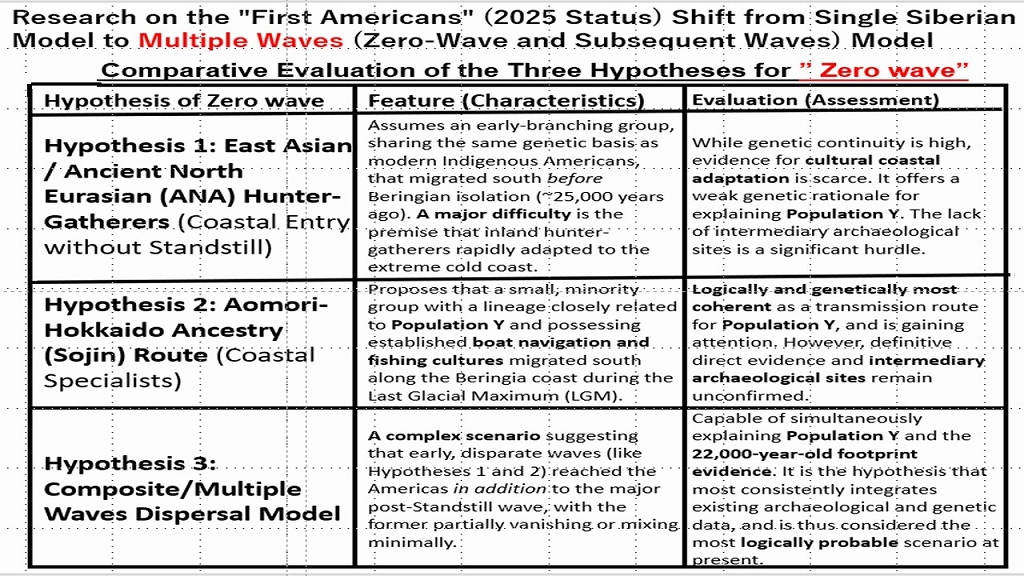
Figure Right: Recent discoveries, including the 22,000-year-old (median age) footprints in New Mexico and Australasian DNA elements (Population Y) in South America, demonstrate that the dispersal solely after the Beringia standstill is insufficient for explanation. This necessitates the consideration of hypotheses based on a “Zero-Wave and Subsequent Waves” multi-layered model.
It is entirely inappropriate to exclude the Sojin (Jomon ancestors/predecessors) from this discourse, especially when considering the focused attention on the South American Population Y—a lineage not found in North American Natives. The Sojin are estimated to have continued northward approximately 30,000 years ago from “East Hokkaido Gateway ” and possessed the necessary adaptability for ice-age coastal environments, despite the finding that Jomon DNA and tooth samples from a few thousand years ago do not align with North American Natives. The academic community must urgently break away from the conventional Single Siberian Origin Model.
—RSoJS #Sojin