
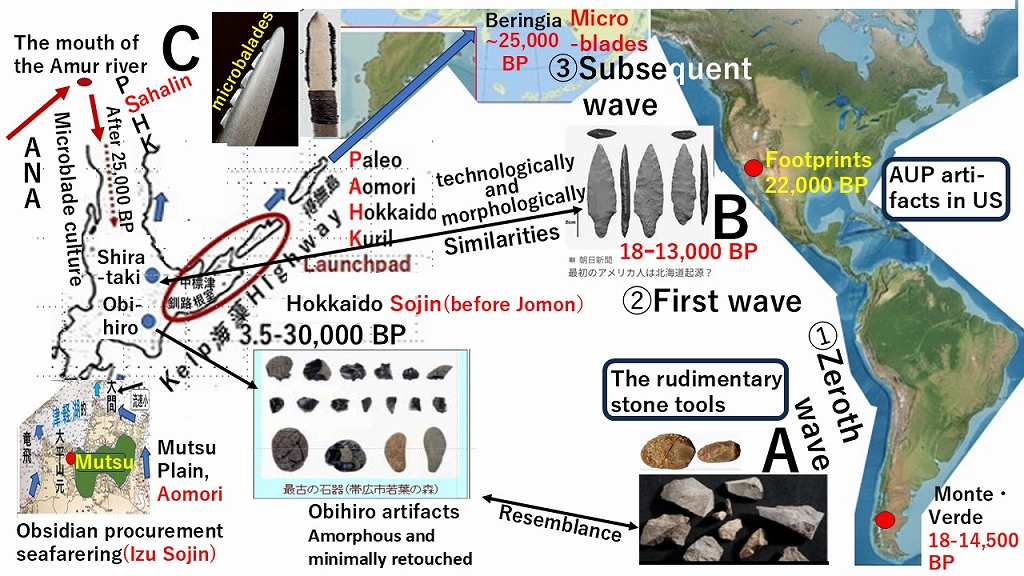
Recent evidence—including fossilized footprints, the Monte Verde site, lithic artifacts, and DNA analysis—suggests a new paradigm for the peopling of the Americas:
1. The Coastal Route and Migration Waves
The “First Americans” likely arrived via a maritime coastal route in three distinct stages. These phases correspond to specific stone tool classifications, illustrating a transition from primitive to sophisticated craftsmanship with striking similarities between Japanese and American artifacts:
- Wave Zero: The earliest exploratory movement.
- First Wave: The primary migration period.
- Subsequent Waves: Later arrivals that further diversified the population.
2. Correcting Ancestral Origins: The “Hokkaido Sojin” (Pre-Jomon)
Traditional scholarship often misidentifies the maritime ancestors who mastered the harsh northern seas.
- The Misconception: These ancestors belonged to ANA (Ancient North Asian) lineages migrating south from Sakhalin.
- The Reality: They originated from Aomori. The Sakhalin microblade culture emerged too late to align with the “First American” migration timeline.
- The Lineage: These populations were formed by a convergence of groups moving north through the Mutsu Plains from both Eastern and Western Japan. Crucially, they were descendants of the seafaring peoples of the Izu archipelago.
—RSoJS
These populations formed through the mixing of groups moving northward across the Mutsu Plains (in northern Japan) from both eastern and western parts of the Japanese archipelago. Importantly, they included descendants of skilled seafaring peoples who, as early as around 38,000 years ago, undertook purposeful maritime voyages from the Izu Peninsula area (near present-day Tokyo on Honshu) to Kozushima Island (in the Tokyo or Izu Islands, off central Japan) to obtain high-quality obsidian—a volcanic glass prized for making sharp stone tools. This involved repeated round-trip crossings of open sea (roughly 50 km each way, even with lower sea levels during the Ice Age), representing one of the earliest known examples of planned, return seafaring by modern humans anywhere in the world.In short, the earliest Americans were likely skilled boat users from a Paleolithic coastal culture in the broader Hokkaido–northern Japan region (sometimes referred to in discussions as “Hokkaido Sojin” or pre-Jōmon groups), who followed the Pacific coastline into the Americas around 20,000+ years ago, bringing their distinctive tool technologies with them. This new view connects archaeology, genetics, and ocean adaptation to paint a more accurate picture of humanity’s arrival in the New World.