
There is a prevailing misconception in Western academia that because the “Coastal Route” to the Americas is gaining traction, early modern humans like Tianyuan Man must have been coastal navigators who directly contributed to the southern Beringian maritime migration.
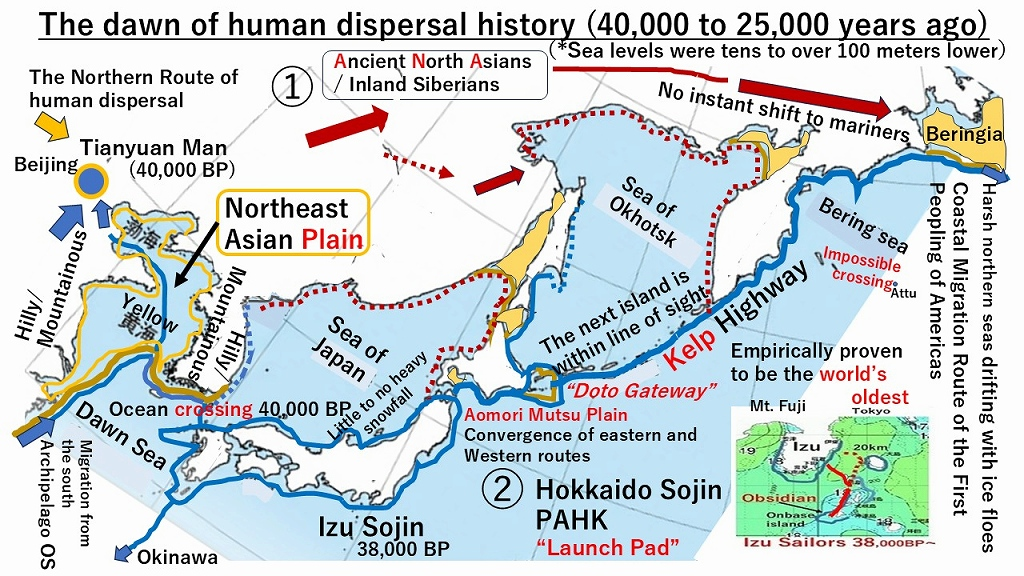
However, paleogeographic reconstructions from 40,000 to 25,000 years ago completely refute this. During this period, sea levels were tens to over 100 meters lower than today. What we now call the Bohai Sea and the Yellow Sea did not exist; they formed the vast, exposed Northeast Asian Plain. Consequently, the Tianyuan Cave site near Beijing was not a coastal area, but located deep within the inland hilly and mountainous terrain. Tianyuan Man was an inland population, though genetically similar to the maritime groups that later utilized the northern coastal highways.
True maritime adaptation developed further east and north along the chain of islands—including Hokkaido, the Kuril Islands, relying on island-hopping where the next island was within line of sight—stretching toward the southern coast of Beringia. This Northern Pacific Kelp Highway Route of human dispersal involved seafaring starting, driven by populations expanding northward from the Southeast Asia and ocean crossing to Northern Kyusyu 40,000 years ago, eventually leading to a convergence of eastern and western routes at the Aomori Mutsu Plain. After the Launch Pad of Aomori/Hokkaido PAHK, they had navigated a harsh northern sea drifting with ice floes and migrated into Amazon and Patagonia.
Therefore, conflating inland populations like Tianyuan Man with the specialized maritime innovators of the Paleo-Asian coastal route misinterprets both the Asian paleo-environment and the true history of human dispersal.