
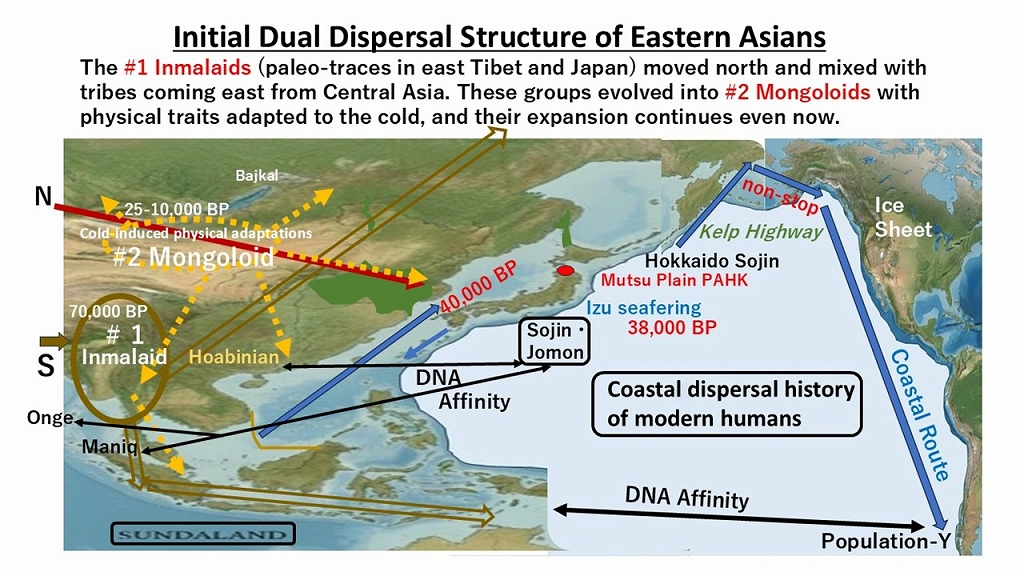
[Right Side] The Coastal Route and the First Americans Recent DNA analysis showing affinities between Southern Asia and South America, combined with archaeological evidence, increasingly supports the Coastal Route hypothesis. A leading candidate for this movement is the Hokkaido Sojin (originating from the Mutsu Plain in Aomori). Their maritime adaptation and the similarities found in American Paleolithic artifacts highlight the significance of the Coastal Dispersal History of Modern Humans (RSoJS).
[Left Side] The Dual-Structure Dispersal in Eastern Asia Following the “Out of the Middle East” expansion, Eastern Asia was shaped by two distinct waves:
- Wave #1 (The Inmalaid Dispersal): Having originated in the Middle East and subsequently starting their migration from Southeast Asia approximately 70,000 years ago, these populations moved northward. They spread throughout the Japanese archipelago, reaching Hokkaido and further north by 35-30,000 years ago.
- Wave #2 (The Mongoloid Dispersal): A later, powerful second expansion resulting from the hybridization of Northern-route populations from Central Asia and the earlier northward-moving Inmalaids. These groups underwent physical adaptations to cold climates, developing the Mongoloid features that remain dominant today.
Note on DNA Similarities: This dual-structure model explains the unique, ancient DNA similarities shared between the Japanese archipelago and the remote Eastern Tibetan highlands—often referred to as a “landlocked island.”
#祖人